Bird conservation in Georgia
Special Protected Areas (SPAs) for birds in Georgia
24 Special Protection Areas for birds — candidate sites selected under the EU Birds Directive for the Emerald network.
Bogdasheni (SPA 23) · Photo: Z. Javakhishvili
Special Protection Areas
0
hectares
0
bird species
0
regions
0
Natura 2000 · Emerald
The Birds Directive and Georgia
The association agreement between Georgia and the European Union, signed on 27 June 2014, includes obligations regarding the implementation of the following two EU directives relevant for the conservation of biological diversity:
- Council Directive 92/43/EEC of 21 May 1992 on the conservation of natural habitats and of wild fauna and flora
- Council Directive 79/409/EEC of 2 April 1979 on the conservation of wild birds
According to the association agreement Georgia is obliged to establish a network of Emerald and Special Protection Areas (SPA) and to initiate priority management measures within four years after signing of the association agreement.
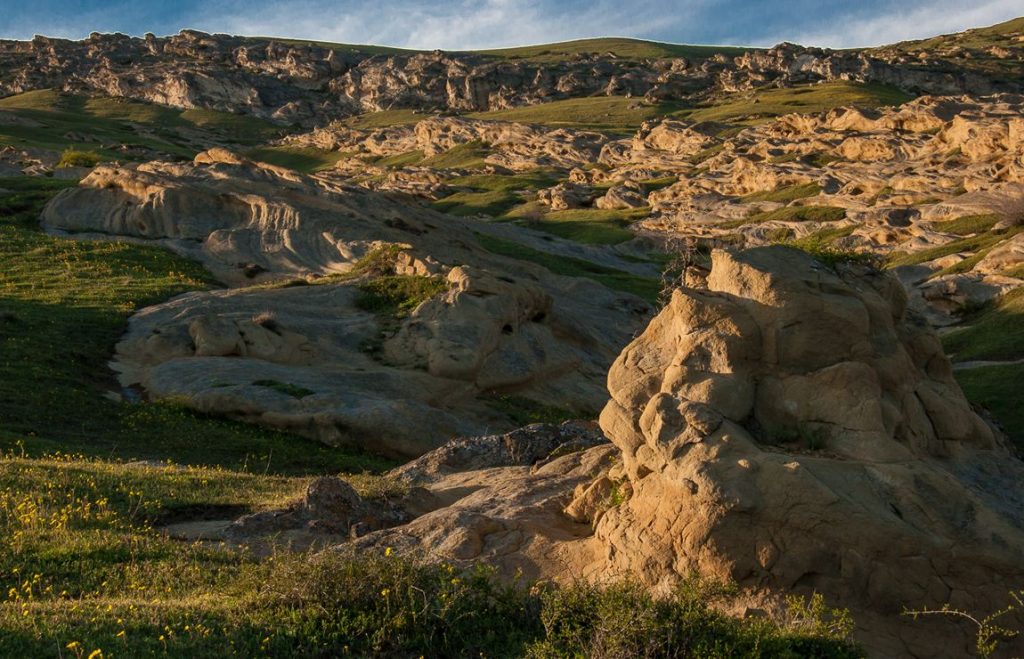
Kvernaki (SPA 10) · Photo: Z. Javakhishvili
SPA 1–24
24 Special Protection Areas
Choose an area for its description, species of concern, monitoring methods and bird list.
The areas at a glance
| SPA | Name | Region | Area (ha) | Altitude (m) | IBA |
|---|---|---|---|---|---|
| 01 | Lagodekhi | Kakheti | 23,065 | 500–3200 | GEO24 |
| 02 | Alazani Valley | Kakheti | 33,670 | 200–250 | GEO25 |
| 03 | Chachuna | Kakheti | 27,794 | 250–500 | GEO11 |
| 04 | Vashlovani | Kakheti | 64,176 | 100–600 | GEO11 |
| 05 | David Garedji | Kakheti | 22,899 | 600–900 | GEO11 |
| 06 | Jandari | Kvemo Kartli | 3,530 | 250–450 | GEO27 |
| 07 | Lower Mtkvari valley | Kvemo Kartli | 10,943 | 300–400 | GEO26 |
| 08 | Khevsureti - Tusheti | Khevsureti; Tusheti | 119,467 | 1400–4000 | GEO22-GEO23 |
| 09 | Khevi | Khevi | 95,461 | 1300–5000 | GEO21 |
| 10 | Kvernaki | Kartli | 12,979 | 500–1000 | GEO20 |
| 11 | Racha | Racha | 89,934 | 1400–3800 | GEO13 |
| 12 | Meskheti | Samtskhe-Javakheti | 41,221 | 1200–2000 | GEO08 |
| 13 | Zekari | Imereti; Samtskhe-Javakheti | 29,567 | 1300–2500 | GEO15 |
| 14 | Shavsheti | Adjara | 24,810 | 1000–3000 | GEO16 |
| 15 | Chorokhi Delta | Adjara | 2,232 | 0–30 | GEO32 |
| 16 | Batumi | Adjara | 26,600 | 20–1000 | GEO14 |
| 17 | Kolkheti | Guria - Samegrelo | 29,970 | 0–10 | GEO04 |
| 18 | Rioni Delta | Samegrelo | 2,939 | 0 | — |
| 19 | Churia | Samegrelo | 3,582 | 0 | — |
| 20 | Khanchali | Samtskhe-Javakheti | 1,805 | 2000 | GEO09 |
| 21 | Kartsakhi | Samtskhe-Javakheti | 3,337 | 1800–2200 | GEO17 |
| 22 | Tabatskuri | Samtskhe-Javakheti | 11,058 | 2000–2300 | GEO18 |
| 23 | Bogdasheni | Samtskhe-Javakheti | 101 | 2000 | GEO30 |
| 24 | Madatapa | Samtskhe-Javakheti | 1,674 | 2100 | GEO31 |
Map of the areas
Click an area on the map for details.
The project
The objective of the Ilia State University is to support the Biodiversity Protection Service of the Ministry of Environment and Natural Resources Protection of Georgia in the selection of candidates to be nominated as Special Protected Areas for Birds (SPAs). In particular, Ilia State University implemented following project activities:
- Identified candidate Special Protected Areas for Birds (as future Emerald sites)
- Performed baseline study for each individual candidate SPA (biodiversity-georgia.net/SPA)
- Prepared of maps of each SPA (biodiversity-georgia.net/SPAmaps)
- Developed a monitoring scheme of the SPAs
- Produced SPA monitoring manual
- Prepared database for monitoring data
- Trained stakeholders in monitoring methods
- Performed monitoring of 3 selected pilot SPAs
- Updated checklist of Bird species of Georgia (biodiversity-georgia.net/aves )
- Produced web page for the SPAs for birds
Selection criteria
The selection process is divided in two stages. In Stage 1 all potential sites are selected by applying the respective Stage 1 criteria. These areas are then considered further using one or more of the judgements in Stage 2 to select the most suitable areas in number and size for SPA classification. In this way Stage 2 is meant to support a consolidation process where the suite of sites selected in Stage 1 is refined, delineations are adapted and the best combination of sites can be chosen.
The criteria presented below shall be subject to comments and discussions with relevant stakeholders, after which an agreed set of criteria will be elaborated.
Selection criteria
Stage 1
- An area that is used regularly by 1% or more of the Georgian population of a species listed in Annex I of the Birds Directive (2009/147/EC) in any season (IBA criteria C2).
- An area is used regularly by 1% or more of the biogeographical population of a regularly occurring migratory or non-migratory species (other than those listed in Annex I) in any season (IBA criteria C3).
- An area that comprises a mirgratory “bottleneck” where over 5.000 storks, or over 3.000 raptors or 3000 cranes regularly pass on spring or autumn migration (IBA criteria C5).
- An area is used regularly by over 20.000 waterfowl (waterfowl as defined by the Ramsar Convention) or 20.000 seabirds or 10.000 pairs of seabirds in any season (IBA criteria C4).
- An area is used by 1% or more of the Georgian population of a species listed on the Georgian Red List with category threatened, endangered or critically endangered.
- An area that is one of the ‘n’ most important in the country for a species with an unfavourable conservation status in Europe (SPEC 1, 2 or 3)1 and for which the site-protection approach is thought to be appropriate (similar to IBA criteria B2).
- An area, where the application of Stage 1 criteria 1-6 for a species does not identify an adequate suite of most suitable sites for the conservation of that species, but which meets the requirements of one or more of the Stage 2 criteria in any season.
Stage 2
- Population size and density
Areas holding or supporting more birds than others and/or holding or supporting birds at higher concentrations are favoured for selection. - Species range
Areas selected for a given species provide as wide a geographic coverage across the species’ range as possible. - Breeding success
Areas of higher breeding success than others are favoured for selection. - History of occupancy
Areas known to have a longer history of occupation or use by the relevant species are favoured for selection - Multi-species areas
Areas holding or supporting the larger number of qualifying species (Annex I, Red List of Georgia, waterbirds, migrating birds) are favoured for selection - Naturalness
Areas comprising natural or semi-natural habitats are favoured for selection over those which do not. - Severe weather refuges
Areas used at least once a decade by significant proportions of the biogeographical population of a species in periods of severe weather in any season, and which are vital to the survival of a viable population, are favoured for selection.
1 The SPEC categories (Species of European Conservation Concern) determine the state of conservation of the species of birds present in the whole Europe, in relation to their European populations and to their distribution, both on the European and the world level (BirdLife International (2004a,b).
SPEC 1 – Species of global conservation concern, i.e. classified as globally threatened, Near Threatened or Data Deficient (mostly congruent with Annex I with few exceptions)
SPEC 2 – Concentrated in Europe and with an Unfavourable Conservation Status
SPEC 3 – Not concentrated in Europe but with an Unfavourable Conservation Status
Abbreviations
Seasonal status at a site
- YR-R
- Year-round resident; breeder, present throughout the year
- YR-V
- Year-round visitor; non-breeder, present throughout the year
- BB
- Breeding bird; breeder, absent during the non-breeding period
- SV
- Summer visitor; non-breeder, present in spring and summer
- WV
- Winter visitor; non-breeder, present in late autumn, winter and early spring
- M
- Migrant; bird of passage, present mainly in autumn and spring
- Cas
- Casual (vagrant) species
- ND
- No data
IUCN Red List
- CR
- Critically Endangered
- EN
- Endangered
- VU
- Vulnerable
- NT
- Near Threatened
- LC
- Least Concern
Other
- SPA
- Special Protection Area for birds
- IBA
- Important Bird and Biodiversity Area
- RLG
- Red List of Georgia
- Annex 1
- Birds Directive (2009/147/EC), Annex I